We’re a few of weeks removed from our last visa-renewal trip to Namibia, and I have to say that I’m happy to have it well behind us. It’s not that Namibia isn’t wonderful – in fact, it’s just the opposite: leaving a beautiful, clean, organized, relatively cheap Windhoek behind to return to filthy, chaotic Luanda wasn’t one of the easier things I’ve done recently. Coming at the six-month mark of our time here (half way, as we’ve recently decided), the trip was a sort of bittersweet celebration. We’re proud at how well we’ve done here in six months – how much we’ve accomplished both in terms of work and in terms of making a home – and how easy it’s seemed despite being difficult and exhausting. We’re excited that we get to return to the US in six months – to return to the comforts we enjoy there and to be closer to our family and friends. We’re sad, however, at how quickly time has passed and how little of it we have left here.
One might reasonably expect that we’ve learned a lot about Luanda in living here a half year, but after our visit to the country next door I can only say that I’m more confused than ever. How country like Namibia which is comprised largely of dessert and boasts a fraction of the wealth of (natural and fiscal) Angola be so much better off?
It’s not that Namibia doesn’t have its problems, to be sure. I feel a fairly intense vibe of racism and there are still some fairly serious problems with poverty. But, when you meet Namibians they ask for how long you’re on holiday instead of saying, “Welcome to hell” as I frequently hear around Luanda. Another difference between there and here is the presence of an educated middle class to manage and run the country. When the Portuguese left all of the knowledge about how to manage and maintain industry and infrastructure left with them. In the 30 years of civil war that followed the situation with local capacity deteriorated further. And while I’m not sure having a white, imported middle-management class, like Namibia’s, would be the best thing for Angola, having a sizable, decently educated group of people seems to make a world of difference in keeping a country functioning.
Despite its problems, though, Luanda is a far nicer place to be now than it was a mere two years ago. This fact has been highlighted by the recent arrival of a friend making her first visit to Angola. Even though she’s been studying and reading about Angola for years and is quite well traveled, she’s been awed by the conditions here in Luanda and how disgusting things are. Last week, as I was showing her around town, I spent a lot of time talking about how much has been improved recently and being surprisingly defensive about the conditions. For example, arriving here in the Bairro Popular this year I was amazed at how relatively little garbage there was in the streets. As compared to two years ago it absolutely gleams; one of our main roads is regularly swept and there’s nightly pick-up of trash that almost works.
However, based on the amount of trash remaining on the streets in our neighborhood among other things, it was pretty clear that our friend was having a hard time believing me that things are actually better today than they were a short time ago. So one day she asked a cobrador (the guy who gets people on and off the taxies and collects fares) if life here has improved. He said it’s more than improved; he said that life here today is good. His statement highlights the difficulty of describing the current situation here. The following two statements are both true: life here is far better than it was 2 year ago; life here is miserable, difficult, and unhealthy. The fact that it’s improved considerably shouldn’t be overlooked, but it also can’t be allowed to detract from the problems that still remain. More than that, given how poor the situation is we can’t afford to have satisfaction with the speed of progress.
As Angola prepares for its first elections since 1992 the ex-pat and international communities are rightfully concerned about how free and fair the elections will be especially given the situation here with government control of media. The effect, however, that the elections seem to be having on the government in terms of pressure to make improvements and pressure to demonstrate their fitness to govern are impressive. Free and fair or not, I’d say that the elections have had a positive effect on the country.
The propaganda on TV, Radio, and Billboards here brags about how little has been accomplished in the mere 6 years that have passed since the end of the war. One television ad, in particular, compares how much rebuilding has occurred here with how long it took in Europe and Japan to recover from two world wars. It’s hard to argue: a lot has changed and a lot is changing – quickly. Moving forward, though, we must hope that the government continues to compare the situation here with the situation abroad and that Angolan’s visit other places as people from other places visit here so that we continue to be reminded that no matter how far Angola has come or how fast, there remains a long way to go.
26 August 2008
Visiting and Visitors

16 July 2008
I’ll pay my electricity bill as soon as the power comes back on
I will. I really will. I promise. This isn’t even a threat. In fact, I’d be happy to pay it today. I just came back from the local EDEL office where such things happen, however, and it isn’t possible because even though we have power here at the house, they don’t. Yes. One more time: I cannot pay my electricity bill because the power company doesn’t have power at their office.
The above paragraph is, of course, prerequisite. I write it in obligation to the unspoken contract between me and this continent what with it being “undeveloped” and I being a “westerner” with a blog. Just between you and me, however, I wasn’t too surprised. It makes enough sense to me that the potential irony is lost. On the way home, just to check, I told my neighbor what had just happened. He waited to make sure I didn’t have something else to add, something that would help explain why I stopped him, and to make sure I wasn’t simply taking an extended pause to try to think of a word in Portuguese, eventually shrugging his shoulders saying, “Yeah. Huh. Maybe tomorrow. Or Friday. Yeah, after the 15th maybe.” It didn’t even occur to him that what I was telling him could be the basis of a humorous anecdote. I’ve come to internalize what he did long ago: there’s no imperative connection between the office where I pay my bill and “the power company,” let alone between “the power company” and the generation and delivery of power.
I had doubts about whether I would be able to pay my bill in the first place. After all, it’s been more than two months since anyone was here to read the meter. I was really going to the office so that at least if anyone from EDEL came by to disconnect the power I could be telling the truth as I handed him his whiskey (a hopefully passable bribe) and told him I was just at the office.
I had been home from my attempt for about an hour when two EDEL men came by the house to read the meter. They were nice: a sweet older man with slurred way of speaking and a polite if somewhat serious younger man. Despite our nervousness, they were uninterested in the status of our account. They wrote down some numbers from the meter and from our paperwork, quickly drank a glass of cold water, and moved on to the neighbor’s house.
I’m going to go try to pay my EDEL bill again on Friday. Maybe the power will be on and maybe the data from today’s collection will be in the system. Maybe not. Maybe I’ll have to return next week. Maybe I’ll still have to bribe a guy to keep him from shutting off our lights. Maybe the power will go out anyway, like it was most of last week, and this will all seem really, really silly. Maybe when I’m at the office next I’ll suggest that they might want to look into getting a generator because the power from EDEL is, you know, really unreliable. And, maybe, after that, the water will come on for the first time this week.
21 May 2008
Being Angolan, and Not
While I wish my most recent trial were ending, I cannot report such good news. I write to you from the comforts of my good friend's home in Maianga where there is air conditioning and, most importantly, electricity. The power in our part of the bairro went out early Friday morning and as of this moment (Tuesday afternoon) has yet to return. Our generator has not worked since day one in the new place and our water only runs if the pump has energy to retrieve it from the tank. Fortunately, we've had good luck with the spigot out front (which we usually use to top off the water tank) and, so, with a small amount of physical labor life at home remains almost comfortable.
It's been a somewhat convenient time for this to happen, as lately I've been contemplating my Angolan-ness. Having no power and having to carry all my water (though not nearly as far as most of my neighbors) has created a nice space in which to consider how well I'm adapting to life here. There are a few Angolan-isms with which I was born and a few that I've acquired in my time here. All-in-all, I'm assimilating rather well but it remains clear that I am not and will never be Angolan. Four months into my stay here seems as good a time as any to give you the current rundown.
I make noise CONSTANTLY, or so I'm told… This may or may not be apparent to you depending on the context in which we've spent time together, but it would appear that if I'm not playing a radio or music just loudly enough to annoy my spouse I am singing, talking, clicking (yes, clicking), whistling, or, worst of all, working. To be fair, making strange noises all day is kind of my job, but I suppose that this doesn't quite justify all of the other racquet. I would kind of like to deny the charge, but have been forced into a situation of self-awareness and I cannot. The good news is that I fit in perfectly here. In fact, if anything, I've got some headroom. Since arriving I've even made some somewhat surprising complaints about life here being too loud. For example, the ladies that we employ listen to the radio all day at volumes just loud enough really wear on you throughout the day; even I'm relieved when they go home and we can turn the damn thing off.
I am a master of the overly long and complicated precursor statement and I repeat the same point ad infinitum as though the slight variation in my examples carries profound meaning… No statement here begins without a precursor. The simplest variation is “olha” (look) as a clause at the beginning of nearly sentence (or, more commonly, “olha, olha, olha…”). Other favorites are, “É como assim…” (It is like this) and “É o seguinte…” (It is the following…) which begin most declarative statements but add no meaning whatsoever. I would be tempted to claim that my lead-ins are important and that they pave the way for the coming information in an important way, but to make such claims would be a folly.
I've picked up the habit of counting money out of a drawer… In every loja here in Luanda (I'd guess Angola, but I can't say for sure) the money behind the counter is kept in a drawer. Not a drawer, however, like you'll find in a cash register, but one rather like my sock drawer. Money received is tossed in casually and change is made by digging through a heap of crumpled bills. The result is best described as dinheiro soup. Larger or well organized shops have two drawers, one for small bills and one for large, with a result that is much the same. In what I must confess was a moment of pride, I recently found myself digging through (read: making a mess of) the top drawer of my desk, where I had put all of my money at the end of the day, for a 200 kwanza note.
I recently began improvising objects out of plastic... É como assim, I've needed a laptop stand for quite some time to facilitate the use of my external keyboard and mouse, and to help cool down an already hot-running laptop in the miserable heat. I didn't bring one because I didn't have room and expected I'd be able to make one out of something. I have been using a stack of books, which took up too much space and caused problems each time I needed to use one of the volumes. After months of contemplation in a world filled with plastic (I mean FILLED; seriously, this is a whole other post), the vision for my perfect laptop stand hit me like a bolt of lightning. With one container and a razorblade I had the below in under 5 mintues. I feel like I'm living the end of the first matrix movie when the hero is able to see that the world is really made of code and he can alter it as he sees fit. I have arrived.
But for all that I may have or may be gaining in common with your average Angolan, the degree to which I am not and will never be one is ever-present. Last week, for example, a woman we know that works as an empregada got beaten by her ex-husband for going to his home to ask for money to help support their three children. She was beaten over the weekend and subsequently missed work (and pay) on Monday as she was seeking care for her mangled teeth and dealing with unresponsive police about the incident. On Tuesday when she went to work, she learned that she was losing one of her two cleaning jobs (the one with more hours, of course) because the husband in that house was sick of paying for a cleaner when “all his wife does” is study full time in university. In her remaining job she works about 15 hours per week and gets paid $120 per month. That's less than $2 per hour but it's also a slightly generous wage by local standards. How she supports her three kids, I have no idea. If she spends her entire salary on food she's got around $4 per day to make it work out. That's about 6 eggs (or 2 small pieces of meat), 2 cups of starch, an onion, and a tomato per day. Give or take. I wish I could tell you her life was unusual or particularly unfortunate, but I can't. It could be going a whole lot worse for her – it is for others. And, while there is plenty of abuse and poverty in the US, but it doesn't compare to the quantity and depth of it here.
And so, really, as amusing as it maybe now and then to marvel at my own budding Angolan-isms, I'm working hard to keep things in perspective. Unfortunately daily life here provides plenty of reminders. I was born in a rich country. I was born with access to all of the privileges afforded white men. I have experienced financial insecurity and have wanted for food because of it, but I do not know poverty or hunger. I am well educated. I have opportunity. I also have an obligation to make a positive contribution in this world. I have yet to figure out how best to do so, but I will learn. Being in Angola will help me. And, maybe, as I work to figure it out, I can pick up that beautiful Angolan ability to laugh and sing and dance, to find a way be kind, to be generous, to be joyful, and to find beauty despite the crushing misery all around.
09 April 2008
I recently had the pleasure of attending a futebol match between our “local” team, Kabuscorp, and 1º de Agosto, one of the dominant forces in Angola’s premiere league. While the quality of the futebol was questionable (even to the untrained eye) the afternoon was incredibly entertaining.
First, a little background: We live in the Bairro Popular which is in Kilamba Kiaxi (which is in Luanda) – our neighborhood area appears in the lower left hand corner of this map (for reference, Ingombota contains the bulk of the central city). The bairro next to ours, just off the map to the lower left, is Palanca. Palanca is known as a war destination for Angolans from the northern province of Zaire and a large immigrant community from the Democratic Republic of the Congo. Portions of the DRC and Zaire province were formerly part of the Kindgom of Kongo which had its capital in Mbanza Kongo (the current-day capital of Zaire province) and the size of the Kongo community in Palanca is large enough that Palanca is sometimes jokingly referred to as "República Democrática do Palanca." Futebol fans in Palanca are quickly becoming known for their rabid support for the team of their local “Kabuscorp Sport Clube Palanca” which was elevated to the top tier of professional teams this year.
As a recently promoted team, Kabuscorp is more or less expected to occupy the bottom of the rankings. This doesn’t appear to put much of a damper, however, on the enthusiasm displayed by their supporters. Three weeks ago underdog Kabuscorp triumphed on the road against Benfica do Lubango, a victory which has been credited, at least locally, to the turn out and volume of their fan base. At the match I attended, cheering for Kabuscorp began a full two hours before play and continued unabated until the 86th minute when 1º de Agosto scored the game’s only, winning goal.
Highlights from the shenanigans included crowd leaders in full body paint, a sizable brass band with incredible volume and endurance, a fire breather or two (of which the police did not approve), taunts at spectators in the building behind us including warnings that their building was going to fall (no small joke in Luanda these days), and special new cheer citing the presence of Kabuscorp’s white fans as evidence of its impending victory. The cheers and songs throughout were in Lingala but a friend of Arthur and Jojanneke from work was able to translate for us. He was initially nervous about doing so as the cheers pretty vicious in their treatment of the other team and their fans, but once Arthur relayed the content of some common Dutch futebol songs our informant was comfortable sharing the gist of their taunts with us.
While normally I’d be dubious of the ability for cheering to have a large impact on the game, it seemed best not to discount the importance of the Kabuscorp support crew. I’ve never seen a team interact with a crowd as much as this one. One of the assistant coaches even came over to the stands before the game to confer with the crowd ring-leaders. Some of the loudest cheering of the game came when the head coach made his tour of the field and tipped his hat to the crowd. While he was on the field everyone in the stands made sure we realized who he was and told how him important he was – he was described to me as "chefe" (a common word here translating more-or-less to boss or chief) as well as king and hero in English. Indeed, despite terrible play by the goalie and despite 1º de Agosto being bigger, stronger, faster, and more talented at every position Kabuscorp managed to keep it tied 0-0 until the very end of the match.
Even if our attendance at the match didn't culminate in Kabuscorp victory, the fallout from our presence continues to be felt -- as recently as this weekend I was stopped in the street and asked about my support for Kabuscorp. I've also heard rumors that were clips of us on the television during the local sports coverage. The only problem with all of this is that Kabuscorp isn’t considered by everyone to be a "real" Angolan team, as many of the players have (apparently) naturalized from the DRC. There’s also the small problem that I now live on the other side of the bairro from Palanca and all of my new neighbors are 1º de Agosto supporters. I do, however, appreciate that Kabuscorp is a huge underdog and cheering in Lingala is a heck of a lot of fun -- even if I don't know what I'm yelling. I’ll have to hear out my neighbors on the case for 1º de Agosto and I’ll report back with my fan status in a few weeks.
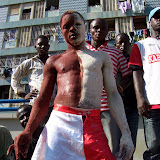 |
| Kabuscorp v. 1º de Agusto |
p.s. Jojanneke took some excellent pictures – keep an eye on her blog for more…
17 March 2008
Cravings, Sponges
.jpg)
Months, if not years, before we left the US were dedicated to carefully compiling and prioritizing lists of the things we need and want to use on a daily basis. The goal of such lists was the ability, when doing our final packing, to make well-considered decisions about what to bring with us and what to leave behind. It felt a somewhat hopeless activity but one at which we felt obliged to make an honest go. The things we brought with us to Luanda are not things that we cannot get here, but rather things that are too expensive (absolutely in the case of, say, electronics or relatively in the case of, say, maple syrup) or of inferior quality to the goods we can buy at home. The calculus was somewhat more difficult than anticipated, because of the wide variety of goods we can buy here in the city. It’s possible to buy nearly anything you could want so it’s not simply a matter of deciding which thing you need or want more. Instead, you need to decide which thing is more convenient to pack given the guessed relative cost or quality of goods here. For example, say there’s a small spot left in your suitcase large enough to bring either one extra notebook or one extra package of binders. You’ve gotten a pass here in the weight category because they’re more or less similar. You still have to decide whether you think paper or binders will be: a) more easily of available – say there’s paper in the local market but you have to go to the city to buy binders, b) cheaper – both in the US and in Angola, and c) nicer – in the long run will you be happier putting nice paper into really crappy binders or really crappy paper into nice binders? I brought binders, because I knew I’d run out of paper anyway.
I have yet to discover any major oversights on our part and there are no sincere laments so far. I wish, perhaps, that we had packed more sunscreen. Given my complexion the formulation I require (read: 8,000+ SPF) is in short supply here; if it exists at all, the rarity makes it inordinately expensive. There are a few goods that we would not have packed but have been surprised not to find, namely baking soda (baking power isn’t a problem) and brown sugar (there’s also an absence of molasses, rendering useless my usual fix). There is more of something things than anticipated: water and power are far more reliable now than on past trips – a very pleasant surprise – and cell-based internet modems are here and relatively affordable so there’s better web access than anticipated. One even looks forward to the qualitative differences expected on some fronts: the soda here is made with sugar and the catsup is largely imported from Europe so tastes more like tomatoes than corn syrup.
The most interesting part of the experience, though, is the discovery of the small things that I’ve taken for granted or, more likely, that I didn’t anticipate could be substantially different. I knew, for example, that the paper I could buy here at reasonable prices is thin and ugly and generally unpleasant to write on. I did not, however, anticipate how seriously the quality of dish sponges could impact my daily experience. The picture at the top of this post is of two dish sponges (front and back). The one on the left is a “nice” one purchased locally and has had approximately two uses; the one on the left was shipped to us from the US (taking up precious, precious space in our measly mail allotment) and has had approximately two weeks of use. Now, I have to confess that I don’t do terribly many dishes here. An empragada comes Monday, Wednesday, and Friday to clean, wash clothes, and do dishes, and the nanny we’ve hired for David does them during his nap on Tuesdays and Thursdays leaving only the weekends. My day, however, is monumentally better if the three cups, two pans, one fork, and 4 sippy cups that I do wash each day can be cleaned with a good, stolid, 3M lovin’, heavy duty kitchen sponge.
Kitchen sponges – who knew? Other items on the list of things to import even though they’re relatively inexpensive and plentiful here: toothbrushes, toilet paper, q-tips, and all manner of kitchen utensils. I’ll keep a running list and post an update later with other top-missed items. In the meantime, the next time you’re in the kitchen and you open one of those fresh, new, beautiful American kitchen sponges, please give a special whiff to the sickly-sweet, processed petroleum odor wafting out of the over-wrought packaging for me.
02 March 2008
Housing Update
We haven’t signed the contract quite yet and we won’t be able to move in until the end of March, but it would appear that (after a full month of looking) we’ve finally secured a new place to live. We’re having a great time living with Arthur and Jojanneke, but we’re excited to have our own place for the first time since November. The new place is absolutely gorgeous and far nicer than we expected to have. You enter though a very nice gate into a covered car port with room for two cars. Off of the small front porch there’s a living room that leads to a hallway with two bedrooms on it, ending in a dining room attached to the kitchen. Finally, there’s a small, enclosed outdoor space off the back where the laundry and such happens. The inside has been very well cared for and is very nice. The place has, if you can believe it, a generator, a reserve water tank and pump, and (wait for it…) air conditioners! These things can’t, of course, keep out all of the daily difficulties here, but should help make some things much, much easier. The water tank and pump are a huge labor savers and the generator is really nice because I expect to work from home quite a bit. The car port is handy (even though we don’t expect to get a car) because will make a nice, large play space for David.
Because there were very few apartments available in the city center in our price range we ended up in the Bairro Popular, after all (where we are staying now and where we stayed in January 2006). The upside of the location is that daily life here is much slower paced and the people are more open than in the city -- we’ll have a much better chance to get to know our neighbors and become a part of our little surrounding community. The difference between the Bairro Popular and the other neighborhood we were looking at, Vila Alice, is much akin to the difference between the suburbs and the city in the US. The benefit to living in Vila Alice would have been the in-town location for meetings. Fortunately, however, the house is on the city-side edge of the bairro making transit to and from the city easier than our current location. We’ll be a 5 minute walk from a major road and from there can be in the city with one minibus ride. We’re also glad that we’re still in the same neighborhood as Arthur and Jojanneke, so that hopefully we can continue to see them regularly.
07 February 2008
Arriving and Food Costs
Life in Luanda begins! We’ve been here for almost a week now and we’ve been productive despite the jetlag, climate change, and the usual developing country entanglements. Mobile phones are working (kind of), laundry services have been secured (temporarily), real estate agents have been contacted (but not heard back from), and the lay-of-the-land has been re-taken here in Barrio Popular (until the rains re-organize the landscape). Daily life is nice as we’ve landed in the welcoming house of generous friends with neighbors we know. The market is near, the power has been off only once with a generator filling-in after dark, and the water mostly lasts until late in the day and sometimes through the evening.
The largest orders of business have been getting the necessities organized and organizing for when we’ll have our own apartment and need our own necessities. Remembering and practicing day-to-day living habits in a somewhat different environment has gone smoothly. We’ve learned what market items are reliably available and have been able to plan somewhat better each day to reduce the number of trips to and the time spent at the market (though we still go around the corner to get something at nearly every meal). Part of the adjustment has been trying to understand what is and isn’t affordable and what will and won’t work in the budget for the year.
One US dollar is currently buying 74 kwanzas. It was 82 in January 2006 and 81 in January 2007 (down from a high of 87). Inflation has been about 15% during the last year to combine with the weak dollar for a serious impact on our purchasing power. A significant portion of our brain power in the last week has been dedicated to currency conversion. Interestingly it seems that by the time we’re done buying kwanzas with dollars and then converting kwanza prices back to dollars to know how much we’ve just spent on an item, we can generally just take the US shelf price plus 15%. It feels silly to chafe at somewhat high US prices for goods, as they should, then, be near to within our usual budget. The usual annual budget, however, doesn’t include $8500 in plane tickets, a couple grand in vaccines, medications, and visas, Portuguese tutors, and a doubling of the rent. All this for a lifestyle that we greatly enjoy but one quite below what most ex-pats would consider tolerable.
To give some idea about what costs are like here in Luanda and to make a record for myself, here’s the break down for an average, un-indulgent day of food for 2 adults and one baby – not including staples like cooking oil (600 Kwz, $8.10/500ml) and spices (200 Kwz, $2.75/jar). All meals are cooked at home with a fair bit more effort and safety consideration than the usual day in a US kitchen. Note of caution: despite 10+ years of delightful veganism, I play the food game very differently here.
Breakfast
6 eggs – 120 Kwz, $1.62
2 sm glasses juice – 120 Kwz, $1.62
2 bread – 50 Kwz, $0.68
Cheese spread portion – 100 Kwz, $1.35
Total: $5.25
Lunch
6 sm. slices of Ham – 100 Kwz, $1.35
6 sm. slices of Cheese – 100 Kwz, $1.35
2 bread - 50 Kwz, $0.68
Cheese spread portion – 100 Kwz, $1.35
Avacado – 50 Kwz, $0.68
Pineapple – 250 Kwz, $3.37
1/4 Can Green Beans – 25 Kwz, $0.34
1/4 Can Red Beans – 25 Kwz, $0.34
Total: $8.78
Dinner
2 cans beans – 200 Kwz, $2.70
Tomatoes – 50 Kwz, $0.68
Carrots - 50 Kwz, $0.68
Onions - 50 Kwz, $0.68
Green Beans - 100 Kwz, $1.35
Green Pepper - 50 Kwz, $0.68
Rice – 45 Kwz, $0.61
Bananas – 50 Kwz, $0.68
Total: $8.06
Snacks
Crackers – 120 Kwz, $1.62
1 can of soda – 60 Kwz, $0.81
Bananas - 50 Kwz, $0.68
Cheese spread portion – 100 Kwz, $1.35
Bottled Water – 120 Kwz, $1.62
Total: $6.08
Grand Total: $28.17 per day, $856 per month, $10,282.05 per year
Wow. Okay. Well. I’m a little shocked myself. I guess I won’t be buying that coffee, a weekly bar of chocolate, or that 30 Kwz peanut candy in the street after all. How does the average person here survive, then, on less than $2/day? We’re not really sure. I mean, we’re not actually sure that they do survive. We are sure that they starve. We clearly don't have $10K in the food budget, just for the record. I'll have to do some more thinking and some more math and some more buying and get back to you on all of this. Maybe I can find a Sam's Club and get some of this stuff in bulk or something. Maybe.
